Shenzhen Summit Highlights China's Strategic Restraint
The Shenzhen trilateral summit revealed China's strategy of constructive neutrality, leveraging its economic and military weight to balance global conflicts without committing to specific outcomes.
By Riya Zielinski ·
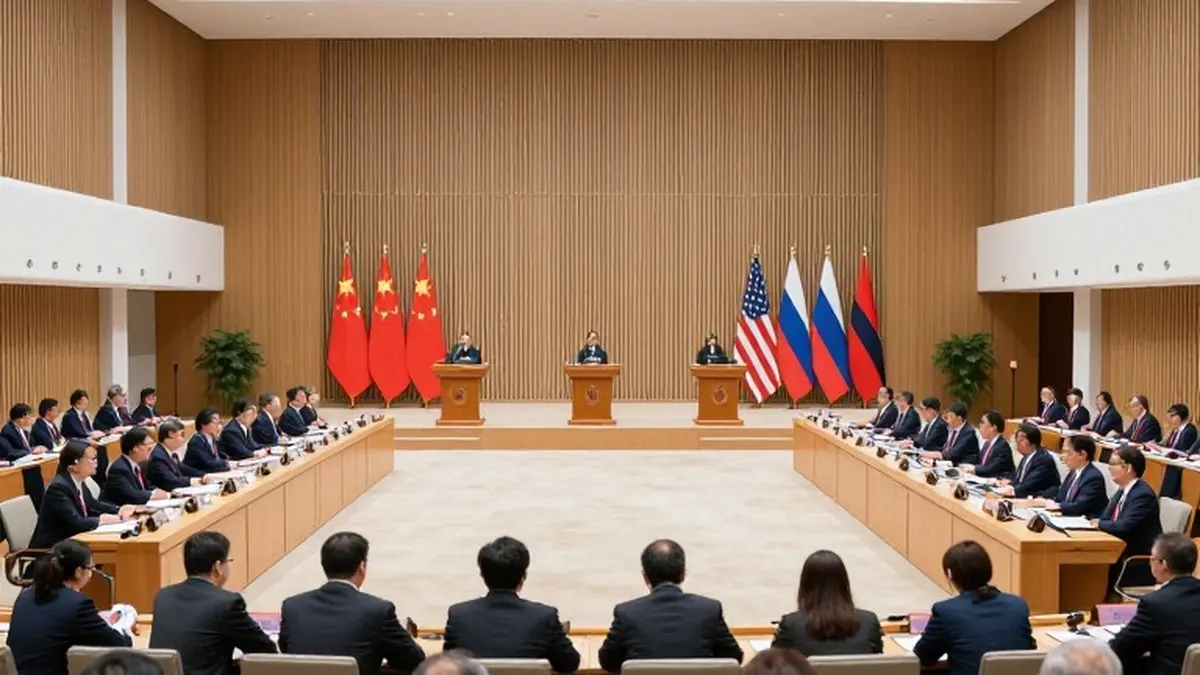
The first trilateral summit between Chinese President Xi Jinping, U.S. President Donald Trump, and Russian President Vladimir Putin concluded in Shenzhen with a declaration focused on peace rather than the geopolitical realignment some observers had predicted. Although the meeting avoided the narrative of a modern Yalta conference where great powers divide the world, it highlighted a distinct contrast among the three leaders. Two of them were engaged in prolonged conflicts that remained unresolved, while the third was not fighting a war and had the capacity to influence the outcomes of the others but chose not to.
Trump arrived in Shenzhen following a significant midterm election defeat that transferred control of both chambers of Congress to the Democrats. He is also managing a conflict with Iran that began in February, which has disrupted energy supplies, drawn in Yemeni Houthis, and affected shipping in the Strait of Hormuz. Putin, meanwhile, came to the summit with a war in Ukraine entering its fifth year, facing Western isolation and a slowing economy.
Ukraine was a key topic on the agenda, discussed at the initiative of the American president. However, U.S. envoys Steve Witkoff and Jared Kushner traveled to Berlin to brief European leaders and Ukrainian President Volodymyr Zelenskyy. Zelenskyy emphasized that decisions regarding Ukraine must involve Ukraine and those affecting Europe must involve Europe. This dynamic suggested that any agreements reached in Shenzhen would still need to align with the demands of the parties directly involved in the conflict.
Beijing’s approach to the war in Ukraine reflects a strategy described by strategists as constructive neutrality. Chinese officials argue that if China had armed Russia, the front lines would look very different today. By not siding openly, Beijing claims it helped prevent the war from widening and lowered the nuclear temperature, maintaining a position that allows it to influence the situation without committing to specific military outcomes.
The ongoing fighting underscored the complexity of diplomatic solutions. While the leaders met, Russian drones struck Kharkiv, and Ukrainian forces targeted oil facilities in Tatarstan and hit the Kerch Bridge for the third time in a week. This simultaneous activity demonstrated that the war is being determined on the ground as much as at the diplomatic table, making it difficult for a single meeting to resolve the conflict.
China’s reluctance to accept commitments on other powers’ terms was evident in nuclear discussions. Washington has long sought a trilateral arms control framework, but Beijing has refused to join on equal terms, citing the disparity in arsenals. China has an estimated 620 warheads, a fraction of the approximately 5,000 held by the U.S. and Russia. The final declaration covered issues such as UN reform, oil supply, and opposition to perceived abuses by the International Criminal Court, along with a pledge that a nuclear war cannot be won and must never be fought.
Critics described the declaration as the lowest common denominator, noting its limited substance. However, Beijing successfully convened the other two powers on its own terms without agreeing to a division of the world. China currently occupies a position similar to the United States held before 1914 and 1939, where restraint sets the terms more than force does. Its economic and military weight, including a manufacturing base comparable to the G7 combined, gives it the ability to alter the trajectory of ongoing conflicts.
Beijing’s treatment of Trump during the summit was revealing. Despite his diminished status at home and abroad, he was given prominent visibility, including a tarmac welcome and a front-row seat in group photos. Commentators interpreted this as a host offering dignity to a weakened guest, allowing Beijing to conserve its leverage while projecting strength. This approach contrasts with the Yalta narrative, where powers carved up the world only to fight over it later.
China is not without vulnerabilities, facing a tightening security perimeter, a struggling property market, youth unemployment, and internal military corruption. Its constructive posture is partly a judgment that exercising influence too freely would expose these limits. For smaller regional economies, the resulting stability is a by-product of this restraint. The Shenzhen summit was less about governing the world and more about balancing it, with China’s greatest power lying in its choice not to enter wars and its refusal to end them on terms set by others.