Iran Targets US Air Base in Kuwait and Bahrain Facilities
Strikes on Ali Al Salem Air Base and the 5th Fleet headquarters occurred early Wednesday morning as regional tensions escalate.
By Riya Zielinski ·
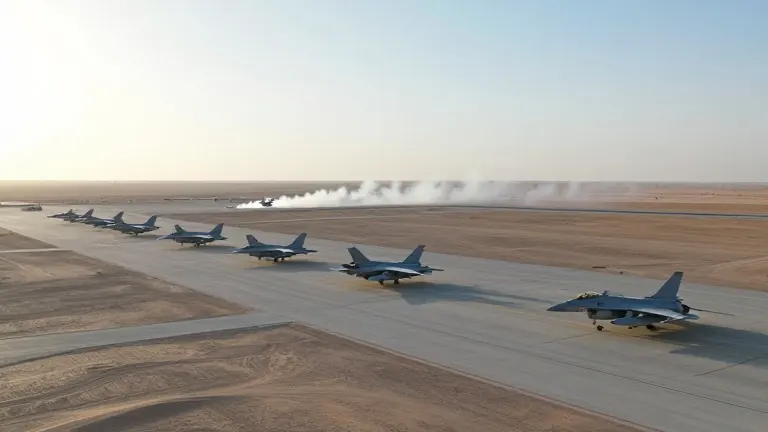
Iran fired at a United States Air Force base in Kuwait and struck facilities in Bahrain in the early hours of Wednesday. The military actions appear to be retaliation for a US fighter jet attack on a missile site in Iran the previous day. These strikes mark a significant expansion of hostilities in the Persian Gulf region.
The US military had attacked a launch site belonging to the Islamic Revolutionary Guard Corps on Qeshm Island on Tuesday. That strike was a response to an Iranian attack on a US radar facility in Bahrain earlier that same day. Iran stated that its recent operations, including strikes on US facilities in Bahrain on Sunday and Friday, were responses to American drone surveillance and attacks on Iranian communication towers.
In Kuwait, the Iranian military targeted air defense systems and drone launch platforms at Ali Al Salem Air Base, according to state-run radio. The Kuwaiti military announced that its air defenses intercepted the drone attacks and reported no initial damage. The Kuwaiti Foreign Ministry called the repeated Iranian attacks criminal and said they threatened the country’s stability.
Bahrain’s Ministry of Interior issued two alerts urging residents to take shelter in the early morning, followed by an all-clear notice. The Bahraini military later confirmed it intercepted several attacks from Iran but provided no details on damage or casualties. Bahrain hosts the headquarters of the US Navy’s 5th Fleet.
Admiral Brad Cooper, head of US Central Command, met in Tel Aviv on Wednesday with Israeli military chief Eyal Zamir and Mossad director Roman Gofman. This meeting occurred as the new round of strikes complicated diplomatic negotiations in a war that began nine months ago. The conflict has increased the risk of a full-scale resumption of war.
US officials have given mixed signals regarding their next steps. President Donald Trump said new attacks were unlikely but ordered a third aircraft carrier and thousands of additional troops to the Middle East. Meanwhile, the state-owned ADNOC oil company in the United Arab Emirates reported that one crew member from a tanker was missing after a Tuesday attack in the Strait of Hormuz. Eleven other crew members were injured and receiving medical care.
Analysts suggest Iran is following a strategy of deliberate, calibrated escalation. Danny Citrinowicz, a researcher at Israel’s Institute for National Security Studies, wrote that Iran aims to increase the military, economic, and political costs of maintaining the naval blockade rather than trigger a total war. He noted that Washington faces a dilemma where a limited response might encourage further Iranian action, while a stronger response risks accelerating the conflict.
Saudian officials told allies that the conflict with Iran-backed Houthi rebels in Yemen could last another six months. The Houthis control a large portion of Yemen, including the capital Sanaa, and have advanced along the Red Sea coast. They have also launched missile and drone attacks on Saudi infrastructure, including King Khalid International Airport in Riyadh and energy facilities.