Trump, Xi, and Putin issue joint peace declaration at historic Shenzhen summit
US, Chinese, and Russian leaders issued a joint peace declaration at a historic summit in Shenzhen, focusing on energy stability, nuclear disarmament, and a shared critique of the International Criminal Court.
By Malik Popov ·
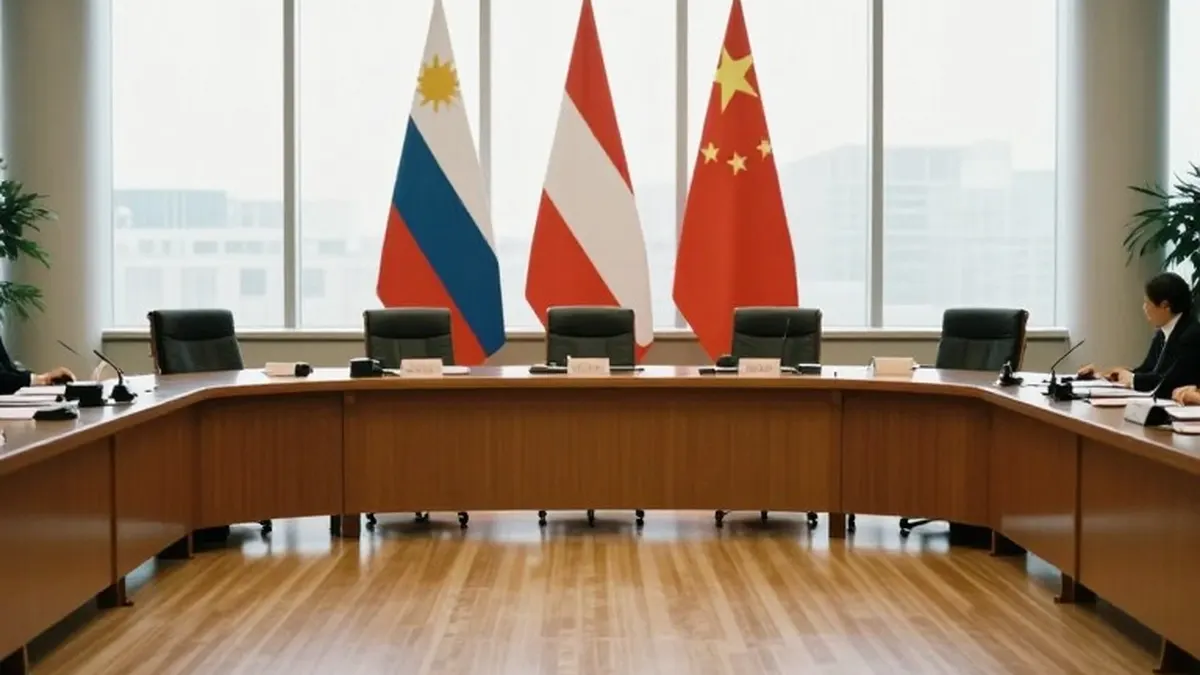
The presidents of the United States, China, and Russia convened for an unprecedented trilateral summit in Shenzhen, China, on Thursday. The meeting, which took place on the sidelines of the annual Asia Pacific Economic Cooperation conference, marked the culmination of three days of intensive diplomatic activity in the region. Leaders from multiple nations had previously gathered in Manila for other summits, including US President Donald Trump, before the focus shifted to this high-level encounter.
Chinese President Xi Jinping chaired the session with US President Donald Trump and Russian President Vladimir Putin. The leaders engaged in a series of bilateral meetings prior to sitting down together for a trilateral discussion that lasted more than an hour. At the conclusion of their talks, the three heads of state released a joint document they described as a peace declaration. This move came at a critical juncture, with ongoing conflicts in Iran and Ukraine taking a heavy toll on global economies and populations.
In his opening remarks, Trump characterized the gathering as a historic moment between three of the world's largest nations, noting that they also hold the planet's three biggest nuclear arsenals. He emphasized that previous leaders often avoided dialogue with those they disagreed with, arguing that no peace was ever forged by declining such opportunities. Xi and Putin echoed the sentiment, urging the countries to shed Cold War mentalities and cooperate constructively to strengthen global stability. All three leaders reiterated that it was their responsibility to protect the world.
A central pillar of the new peace declaration is the reaffirmation of the importance of stable energy flows. This commitment is particularly significant given the volatility in global energy supplies since the US attack on Iran in February. Tehran subsequently closed the Strait of Hormuz, a critical waterway that previously handled a fifth of the world's oil supplies. Additionally, Ukrainian attacks on Russian energy facilities have compounded these issues. However, analysts note that it remains unclear how this promise will be realized, as there is no immediate end in sight for either the US war on Iran or Russia's war on Ukraine.
The summit also produced significant statements regarding nuclear strategy. Before the trilateral meeting began, Xi stated that nuclear weapons should be comprehensively banned and thoroughly destroyed to build a nuclear-free world. He added that a nuclear war cannot be won and must not be fought. This stance was adopted in the joint declaration, with the three countries pledging to hold dialogues on reducing nuclear risks and preventing proliferation. Trump noted that the three nations are uniquely positioned to discuss these matters due to the size of their arsenals. He also mentioned that Xi agreed with him that the Strait of Hormuz needs to remain open and that Iran must not be allowed to possess nuclear weapons, despite Tehran's assertion that its nuclear mission is for civilian purposes.
While the three leaders met in Shenzhen, European leaders gathered in Berlin for a meeting of the so-called Coalition of the Willing, a group coordinating support for Ukraine. This juxtaposition has led some analysts to speculate about the emergence of a G3 bloc. Next month, Trump is set to host the G20 Summit in Miami, and Xi is expected to attend. Although Russia is also a G20 member, Putin has skipped recent gatherings due to an International Criminal Court warrant and European reluctance to share a room with him. Trump has, however, invited Putin to the Miami summit, noting that the US is not part of the ICC and is therefore under no obligation to arrest the Russian president.
The peace declaration also included a pointed critique of the International Criminal Court. The three leaders demanded that the ICC and similar institutions not abuse their positions. None of the three nations are members of the court. The US has had an adversarial relationship with the ICC, which intensified after investigations into US soldiers in Afghanistan and an arrest warrant for Israeli Prime Minister Benjamin Netanyahu. The US has now made the dismemberment of the ICC an official goal and has imposed sanctions on its officials. Russia has become fiercely opposed to the court following the arrest warrant for Putin. China, previously lukewarm toward the institution, has become a strident critic after warrants for other sovereign leaders, including former Philippine President Rodrigo Duterte, and petitions regarding the Uighur community in Xinjiang.
Putin described the trilateral discussions as very frank, stating they helped the leaders better understand one another. As the world watches to see if this marks the start of a new G3 dynamic, the coming weeks will likely provide further clarity on how these agreements will be implemented.